 The Ordinary Harvest
Roasted Vegetable Grain Bowls, Built by Ratio
- One grain, one tray, one sauce, four proper lunches
- Ingredients for four bowls
- Wash and dry before you roast
- Cook the quinoa gently
- Give the sweet potato a 15-minute lead
- Whisk the tahini past its awkward phase
- Assemble by weight or by eye
- The formula behind the recipe
- Substitutions that respect cooking time
- Meal prep without texture surrender
- Troubleshoot the tray, not your character
One grain, one tray, one sauce, four proper lunches
For four roasted vegetable grain bowls, cook 200 grams rinsed quinoa in 350 grams water. This is a deliberately lean starting ratio for fluffy grains; if your quinoa package specifies a significantly different ratio, follow its directions. Roast 500 grams sweet potato and 150 grams red onion at 425°F (about 220°C) for 15 minutes, then add 350 grams broccoli and 240 grams drained chickpeas for another 15–20 minutes. Divide everything among bowls and finish with a lemon-tahini dressing.
The sequence matters. Sweet potato needs a head start; broccoli needs breathing room; cooked chickpeas need browning rather than another full childhood. Cutting evenly and keeping the pan uncrowded do more for flavour than adding an adjective to the menu.
This recipe makes four main-meal bowls. It is vegan as written and can be gluten-free when every packaged ingredient is verified and cross-contact is prevented.
Ingredients for four bowls
Quinoa
| Ingredient | Weight | Useful equivalent |
|---|---|---|
| Dry white or tricolour quinoa | 200 g | About 1 cup plus 2 tablespoons |
| Water | 350 g | 350 ml; about 1 1/2 cups minus 1 teaspoon |
| Fine salt | 3 g | About 1/2 teaspoon |
Quinoa brands and pan shapes vary. If your package gives substantially different liquid directions, follow the package on the first cook and record the result. The method below uses a tight lid and a very gentle simmer.
Roasted vegetables and chickpeas
| Ingredient | Weight | Preparation |
|---|---|---|
| Sweet potato | 500 g | Scrubbed, cut in 2 cm cubes |
| Red onion | 150 g | Cut in 2 cm wedges |
| Broccoli florets and peeled stem | 350 g | Cut in similar bite-size pieces |
| Cooked canned chickpeas | 240 g drained | Rinsed, drained, dried |
| Olive oil | 45 g | About 3 tablespoons plus 1 teaspoon |
| Fine salt | 7 g | About 1 1/4 teaspoons |
| Ground cumin | 3 g | About 1 1/2 teaspoons |
| Smoked paprika | 2 g | About 1 teaspoon |
| Black pepper | 1 g | About 1/2 teaspoon |
A typical can may yield around 240 grams drained chickpeas, but package sizes and drained weights vary. Weigh the cooked chickpeas after draining. A little more or less is harmless; dry chickpeas are not a direct substitute because 20 minutes of roasting will not cook them.
Lemon-tahini dressing
| Ingredient | Weight | Useful equivalent |
|---|---|---|
| Tahini | 80 g | About 1/3 cup |
| Fresh lemon juice | 45 g | 3 tablespoons |
| Cool water | 30 g, plus 15–30 g as needed | 2 tablespoons, plus more |
| Maple syrup | 10 g | About 1 1/2 teaspoons |
| Finely grated garlic | 3 g | 1 small clove |
| Fine salt | 3 g | About 1/2 teaspoon |
Tahini is sesame, a major allergen in the United States. Check every label and prevent cross-contact for anyone with an allergy. “Just a drizzle” remains enough to matter.
Wash and dry before you roast
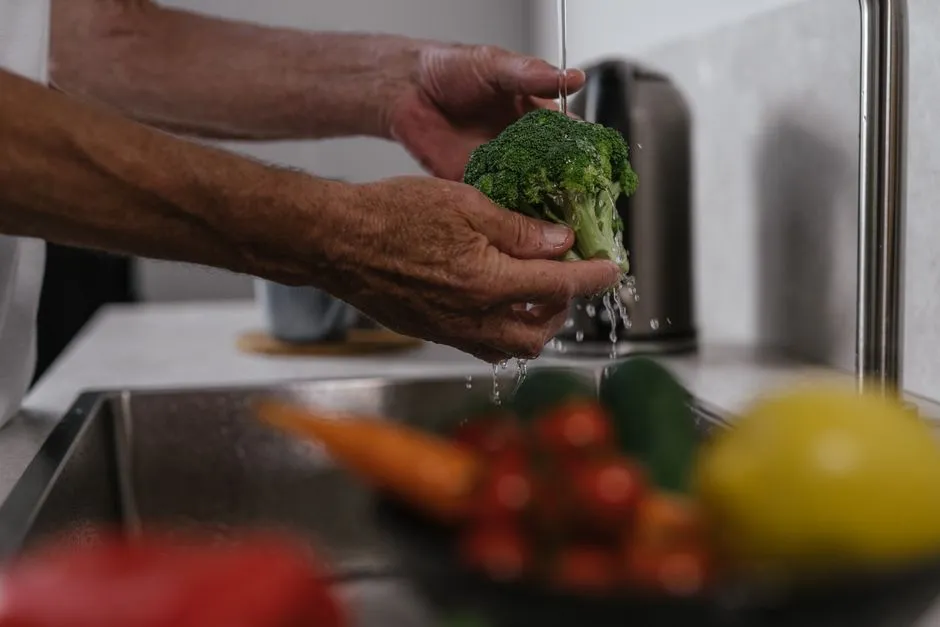
Wash your hands for at least 20 seconds. Rinse the sweet potato, onion before peeling, broccoli, and lemon under running water. Scrub the sweet potato with a clean produce brush. Dry everything well with clean towels.
Plain running water is the recommended method; soap and produce wash are not required. Our guide to washing fruit and vegetables safely covers leafy, firm, delicate, and pre-washed produce.
Dry surfaces brown sooner. Water clinging to broccoli must evaporate before roasting begins, and a crowded wet tray traps steam instead of encouraging browning.
Cook the quinoa gently
Put the rinsed quinoa, 350 grams water, and 3 grams salt in a medium saucepan with a close-fitting lid. Bring to a boil over medium-high heat. As soon as it boils, stir once, cover, and turn the heat to its lowest setting.
Cook for 15 minutes without lifting the lid repeatedly. Remove from the heat and leave covered for 10 minutes. Uncover and fluff with a fork. The grains should be tender and separate, with no puddle at the bottom.
If water remains, cover and cook over the lowest heat for another 2–3 minutes, then rest again. If the pan dried before the grains softened, add 30 grams hot water, cover, and continue gently. Burner output and lid fit can change how quickly the measured water is absorbed or lost.
Spread the cooked quinoa on a clean tray if preparing it for cold storage, which helps it cool promptly. Do not leave a deep hot pot at room temperature for hours.
Give the sweet potato a 15-minute lead
Place one rack in the centre of the oven and preheat to 425°F (about 220°C). Use a large rimmed metal half-sheet pan. If your only pan is smaller, divide the vegetables across two trays rather than stacking them.
Combine the sweet potato and onion with 25 grams olive oil, 4 grams salt, half the cumin, half the paprika, and half the pepper. Toss until the surfaces are lightly coated. Spread in one layer with visible space.
Roast for 15 minutes. The sweet potato will not be done yet; this is its head start. Meanwhile, toss the thoroughly dried broccoli and chickpeas with the remaining 20 grams oil, 3 grams salt, and remaining spices.
After 15 minutes, turn the sweet potato and onion with a spatula. Add the broccoli and chickpeas, redistributing everything into a single layer. Roast another 15–20 minutes.
The tray is ready when:
- a knife slips into the sweet potato without a hard centre;
- broccoli stems are tender and the edges are browned;
- onion tips are caramelised rather than black;
- chickpeas are hot and lightly crisp outside.
Begin checking at the 15-minute mark after adding broccoli. Small florets and dark pans brown quickly. If the sweet potato remains firm while broccoli is ready, remove the broccoli and chickpeas to a clean plate and return the sweet potato for 5–10 minutes.
Whisk the tahini past its awkward phase
Put tahini, lemon juice, maple syrup, garlic, and salt in a bowl. Whisk. A small addition of water or acid can make sesame paste seize and thicken before it re-emulsifies as more water is whisked in.
Add 30 grams cool water gradually while whisking. Continue with another 15–30 grams until the dressing falls from a spoon in a thick ribbon. Different tahini brands need different amounts. Taste and add lemon, water, or salt in small measured increments.
For a sesame-free alternative, make a lemon vinaigrette with 60 grams olive oil, 45 grams lemon juice, 10 grams maple syrup, 3 grams salt, and black pepper. Check every substitute for the diner’s specific allergens; seed and nut butters are not interchangeable from a safety perspective.
Assemble by weight or by eye
Divide the quinoa among four bowls. Add one quarter of the roasted mixture to each and spoon over one quarter of the dressing. If using a scale for meal prep, weigh the finished quinoa and roasted mixture separately, then divide each total by four. Cooked yield varies with evaporation, so dividing the actual result is more accurate than inventing a universal final weight.
Optional finishes include chopped parsley, toasted pumpkin seeds, chilli flakes, lemon zest, or a spoonful of plain yoghurt. Each changes allergens or dietary suitability. Pumpkin seeds may face cross-contact; yoghurt adds milk. The base recipe is complete without a garnish.
Serve warm, room temperature for a short meal period, or chilled after prompt refrigeration. Do not leave assembled bowls at room temperature through an afternoon and call them meal prep.
The formula behind the recipe
The four-bowl structure is easy to remember:
- 200 grams dry grain cooked by its own method;
- 1,000 grams raw vegetables before trimming adjustments;
- 240 grams cooked pulses;
- 45 grams roasting oil;
- about 170–200 grams dressing, depending on added water.
This is a culinary ratio, not a nutrition prescription. Individual energy, sodium, carbohydrate, protein, and allergy needs vary. A registered dietitian or clinician can adapt meals for medical conditions.
The formula makes substitution possible without pretending all ingredients cook alike. Keep the overall vegetable mass near 1 kilogram, but give dense roots a head start and add tender vegetables later. Cook every grain by a method suited to that grain.
Substitutions that respect cooking time
Replace sweet potato with the same weight of butternut squash cut to 2-centimetre cubes; begin checking early because variety and ripeness matter. Carrots can replace up to half the sweet potato when cut smaller.
Replace broccoli with cauliflower in similarly sized florets. Brussels sprouts need trimming and halving; place the cut face against the pan. Courgette cooks more quickly and releases more water, so use a second pan or add it only for the final 12–15 minutes.
Replace chickpeas with an equal drained weight of fully cooked green lentils. Add lentils only for the last 5–8 minutes so they heat and dry slightly without becoming hard. Never scatter uncooked lentils on the tray.
Brown rice, barley, farro, millet, and other grains need their own liquid ratios and timing. Barley and farro contain gluten; use verified gluten-free quinoa or rice and prevent cross-contact when that matters.
Organic ingredients are optional. The organic-versus-natural label guide explains what U.S. certification claims do and do not promise. Choose sound food that fits your budget and values, then cook it well.
Meal prep without texture surrender
For the best texture, store quinoa, roasted vegetables, and dressing in separate shallow covered containers. Refrigerate within two hours of cooking, or within one hour when the surrounding temperature is above 90°F (32°C). Use within 3–4 days.
Reheat cooked quinoa and vegetables to 165°F (74°C), then add cold dressing. Add 1–2 teaspoons water before reheating quinoa if it has dried, and stir midway when using a microwave so cold pockets do not hide beneath the surface.
The dressing thickens in the refrigerator. Whisk in cool water one teaspoon at a time until it loosens. If storage time or temperature is uncertain, discard the food; smell is not a safety test.
Freezing is possible for quinoa and roasted sweet potato, though broccoli softens on thawing and tahini dressing may separate. Freeze components promptly in meal-size portions, thaw safely in the refrigerator, and whisk the dressing after thawing.
Troubleshoot the tray, not your character
Pale vegetables: The pan was crowded, the produce was wet, or the oven was not fully heated. Dry more thoroughly and use two pans.
Burnt broccoli, hard sweet potato: Pieces were uneven or everything started together. Cut roots consistently and preserve the 15-minute head start.
Dry quinoa: The heat was high, the lid leaked steam, or the pan was too broad. Add a small measured amount of hot water and finish gently.
Bitter dressing: Tahini can be naturally bitter, and too much garlic or scorched lemon pith compounds it. Add water and a little maple syrup; change brands next time if the tahini itself tastes unpleasant.
Bland bowl: Season components, not just the top. The quinoa water, roasting tray, and dressing each receive salt. Add acid at the table before adding more salt.
A bowl is not virtuous because it is beige and labelled natural. It is good because the grain is tender, the edges are browned, the sauce is sharp, and the person eating it wants another forkful.
Frequently asked questions
Can I use brown rice instead of quinoa?
Yes, but do not reuse the quinoa water and timing. Cook 200 grams brown rice according to its package or a method developed for that variety, then divide it among the bowls. Brown-rice cooking time and absorption differ by type. For gluten-free service, verify every packaged ingredient and avoid cross-contact; quinoa and rice are naturally gluten-free, but processing and sauces can introduce risk.
How do I stop roasted vegetables getting soggy?
Dry washed vegetables, cut them evenly, use a large metal pan, coat rather than drench them with oil, and leave space between pieces. Add quicker-cooking broccoli after the sweet potato has roasted for 15 minutes. A crowded pan traps steam. If your pan is small, use two pans and rotate racks; do not pile everything into a deeper layer.
Can I use dried chickpeas in the grain bowls?
Yes, but cook them fully before beginning this recipe; the roasting stage is only for browning cooked chickpeas. Soak and cook dried chickpeas with a reliable method until tender, or use a pressure-cooker recipe developed for your appliance. Do not substitute dry chickpeas directly on the tray. Their cooking time, hydration, and food-safety handling are separate from the vegetables.
What can replace tahini in the dressing?
For sesame allergy or preference, use an unsweetened seed butter that is safe for the diner, or make a simple lemon vinaigrette with 60 grams olive oil, 45 grams lemon juice, 10 grams maple syrup, 3 grams salt, and pepper. Seed and nut substitutions have their own allergy risks. Check labels and avoid cross-contact rather than assuming a different jar is automatically safe.
How long do grain bowls keep in the refrigerator?
Refrigerate the cooked components within two hours, or within one hour above 90°F (32°C), in shallow covered containers. Use within 3–4 days and reheat cooked leftovers to 165°F (74°C). Store dressing separately for better texture. Do not rely on smell alone to establish safety; when storage time or temperature is uncertain, discard the food.
Do the vegetables need to be organic?
No. The recipe works with organic or conventionally grown vegetables. Choose sound produce that fits your availability, values, and budget, then wash it under running water and handle it safely. Organic is a regulated production label in the United States, not a requirement for flavour, a guarantee of superior nutrition, or permission to skip washing and refrigeration.